Would you like to have big, round shoulders that look like they just fell out of a coconut tree? If the answer is yes, this article is for you. But we’re not just going for volume; my training philosophy focuses on a fast, effective and, above all, safe shoulder routine. Because, as I’ve learned over the years, if you want to train for a long time, you have to avoid injury and overload. This is where the training plans of the Bilbo Method.
So let’s give your deltoids as much stimulation as possible without compromising your hamstrings and joints. Get ready to set your shoulders on fire.
When we talk about a shoulder routine, many people think of lifting as much weight as possible. And while progressive overload is critical, it’s not everything. The real secret to sustainable growth is more technique and less ego.
My approach is simple but brutal: give the muscle a full stimulus with as little risk as possible. To achieve this, the key is movement control. Instead of going for the full stroke, we modify technique and speed so that tension is always maintained on the target muscle. This way, with less weight, you will achieve better results.
In addition to proper technique and weight control, working on stability and mobility with rubber bands is key to preventing shoulder injuries. Here are 5 exercises with rubber bands to take care of your shoulders that complement this routine and strengthen tendons and joints.
The Military Press is the king of shoulder exercises, and the basis of this routine. We will focus on the barbell version for a greater stimulus, although if you feel more comfortable, you can use dumbbells. It is very important that you know how to do the military press to avoid injury.
The first thing is the position: grab the bar a little wider than your shoulders and bring it to your chest, with your elbows slightly in front of the bar. Avoid leaning too far back. Once you’re ready, push the bar up in a controlled manner.
In my experience, the most critical point is the stroke. Many people lower the bar down to their chest and come up to lock out their elbows. Not only does this take stress off the muscle, but it can seriously compromise your joints. In this shoulder routine, we’re not going to go all the way up, either to the top by locking the elbows or to the bottom of the stroke. The key is to stop the downstroke muscularly, without bouncing, and come up hard.
For the first set, we are going to apply what I call the Bilbo Method. It will be an explosive Set, with a controlled path, between 15 and 30 repetitions. The goal is to get the muscle ready so that with little weight the rest of the workout will go smoothly. In this phase, do not aim for muscle fatigue, but for total activation. Once you’ve completed it, your shoulders should be saying, “What’s going on?”.
The next two Sets we will do with a heavier weight and in a more controlled manner, aiming for 8 to 12 reps. The speed of the repetition is crucial: go up fast, but control the descent.

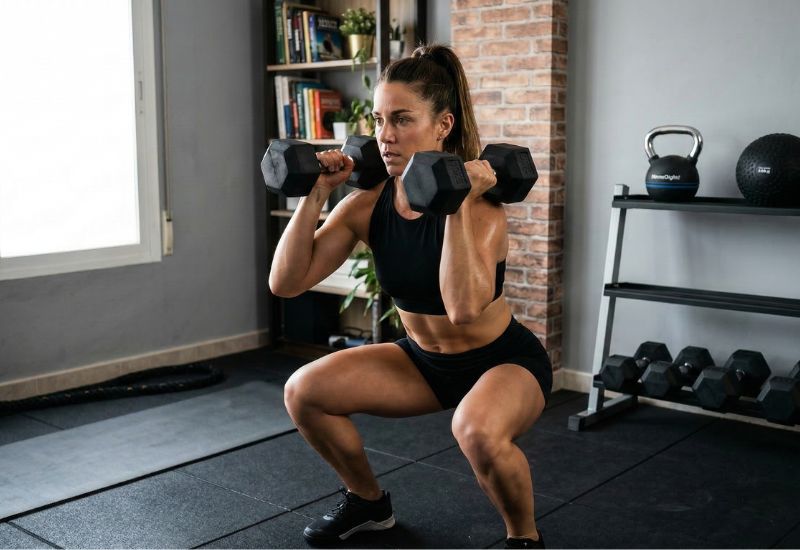
If the Military Press gives you volume, the lateral raises are the ones that sculpt the round shape of your deltoids. For this exercise, forget the barbell and use dumbbells.
By this point in the routine, your shoulders will already be quite fatigued. This means you need very little weight to feel the congestion. That’s why it’s critical to leave your ego out of it. Don’t compare yourself to the guy next to you; if you’re not capable of doing a full set with the weight you have, drop it. It’s better to use 5 kg and feel how it burns the muscle than to lift 20 kg cheating with your back or swing.
Technique is vital: raise the dumbbells to shoulder height, with elbows slightly bent, and lower in a controlled manner, without letting the weight rest on the legs. What we are looking for is that you do not lose tension in the shoulder at any time. Remember, the movement must be muscular, not bouncing or “hip-swinging”.
Here we will do two more Sets, between 8 and 12 repetitions, looking for the angle where you feel the work best.

To finish things off, we move on to the birds. This exercise, if done right, is one of the best ways to work the back portion of the shoulder. If you want that 3D effect on your shoulders, this exercise is a must.
If you feel more work lying on a bench, no problem. The key is the same: technique, control and feel the burn. Do 8-12 reps and find the spot where you feel it best.
Here’s a quick summary to get you started:
Rest 1.5 to 2 minutes between exercises to maintain pace and intensity.
The shoulder routine consists of a total of 6 Sets. It is low volume but high intensity, ideal for those looking for fast and efficient results.
Engorgement is that “bloated” feeling in the muscle that appears during exercise. It is a signal that blood flow and nutrients are getting to the area, and is a key factor in muscle hypertrophy or growth.
Of course it is. In fact, the “more technique, less weight” philosophy is perfect for beginners. It will allow you to learn the moves safely and build a solid foundation before you even think about lifting heavy weights.
This shoulder routine will not only give you more muscle volume, but it will bring you joint health and greater control in the movement of all your exercises. I dare you to try it. If you do, come back here and leave me your impressions, I’m sure you won’t regret it!

Expert in strength training and physical tests for civil service candidates. With over 30 years of experience and multiple national and European records, he shares his methods to improve strength, endurance, and performance safely.