By Jesús Varela – Creator of the Bilbo Method
Over the years I have realized one thing very clearly.
Training at home works. Very much so. But only when you know what you’re doing.
I say this because I see it every week. People who train, who sweat, who perform… and still don’t make progress. Sometimes it’s a silly detail: a misplaced elbow, going down without control, not resting enough. Or simply not knowing what to train today and what not to train today.
It happened to me too. I trained for years believing that the more I did, the better. And no. It took me time to understand that progress comes from doing the right thing, well done, and repeating it with head.
That’s why I insist so much on having a plan. Not a perfect one. A clear one. One that suits you and what you have at home.
If you are training on your own and you want to stop beating around the bush, in the Bilbo Team Training Plans I explain exactly that: how to organize the week, which exercises are worthwhile and how to progress without putting your joints at risk, even if you’re just starting out.
Here I am going to talk about the mistakes I see the most when training at home. Normal mistakes, nothing rare. And also how to correct them without complicating your life, so that you start to notice real changes.
Training with body weight or dumbbells is great, but many people make mistakes that slow down progress. Here are the most common ones I see in my consulting sessions:
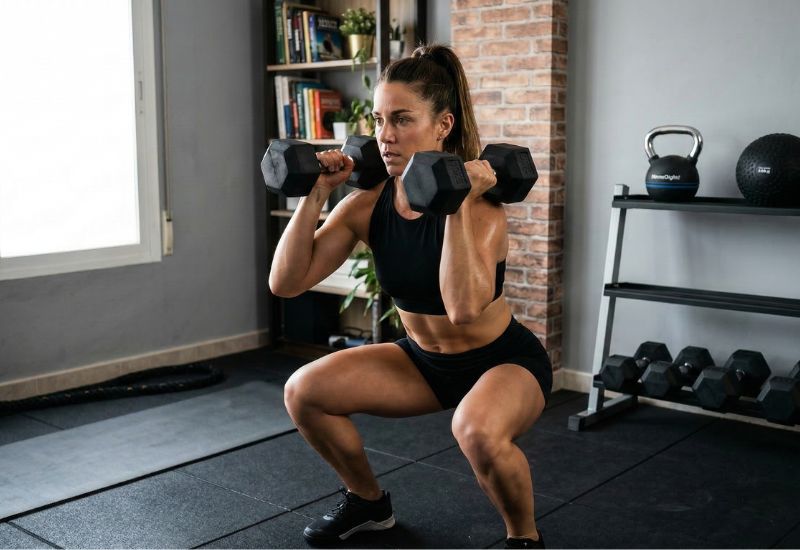
Lifting and lowering without control may seem like more exercise, but in reality you are losing effectiveness. My recommendation, especially at the beginning do the centric phase slowly and controlled, and the concentric at maximum speed, controlling the movement, even in exercises like squats or dumbbell shoulder presses.
It is normal to want to lift more kilos, but if your technique is not perfect, the muscle will not work properly. Before lifting weights, master your technique and maintain constant tension. This applies to Bench press, biceps curls or pull-ups at home.
Doing a half stroke to do more reps is a classic mistake. Each exercise has a range of motion that maximizes muscle activity. Complete the entire movement and feel the muscle working.
A good five-minute warm-up with rubber bands before starting can be the difference between a productive session and an injury.
If you want to learn how to correctly execute the exercises, I recommend this home workout with dumbbells that we prepared step by step for beginners.
There’s no point in training hard if your routine doesn’t have a progression plan. Here’s how to organize your workouts:
The chest is one of the muscle groups where I see the most mistakes when training at home. Look at descent control, shoulder position and how to maintain constant tension without the need for heavy weights.
In shoulder training, opening the elbows too wide or lowering them uncontrollably often leads to discomfort. Here’s how to work the shoulder safely and effectively, even with little equipment.
The biceps looks simple, but poorly executed it loses most of its effect. Watch the rhythm, the full stroke and how to avoid swaying to get the muscle to do the work.
Now that you have seen how to execute the exercises well, it makes more sense to talk about how to organize the week and progress without stagnating.
To gain strength and muscle mass at home, I recommend alternating muscle groups and combining strength exercises with HIIT cardio work:
This structure works with either a home strength board, adjustable dumbbells or elastic bands. The key is to progress each week, either by increasing reps, Sets or weight.
If you always do the same thing, your body will stagnate. Organize your routine by combining weeks of higher reps with weeks of lower reps, progress in weight or reps. This applies to all exercises from shoulder presses to dumbbell squats.
For a practical example, you can check out these the 21 best exercises to train your legs at home and adapt them to your routine.
HIIT is not just for fat loss; it also improves endurance and muscular strength. A couple of 15-20 minute home hiit training sessions combined with your strength routine will accelerate results.
To train safely and effectively, you don’t need a full gym. My recommendation is to invest in basic and versatile equipment:
With these tools you can cover almost all strength exercises at home for beginners and make steady progress.
If you want to learn advanced techniques with dumbbells and barbell, do not miss our article Optimize your chest workout: advanced techniques for dumbbell presses.
Nothing destroys motivation faster than an injury. Here are my tips from experience:
For a complete guide to strength exercises at home, you can also check out. The best abdominal exercises at home.
If you’ve made it this far, you already know the basics: training at home works, but only when you stop improvising.
Most mistakes do not come from a lack of desire, but from not having a clear plan adapted to your level.
👉 That’s just what I work on in Bilbo Team’s Bilbo Team’s training plans. Structured programs so you know what to train every day, how to progress and how to gain strength and muscle mass without getting injured, even if you start from scratch.
In the end, training is not just about moving weight; it’s about learning to listen to yourself, to improve a little bit every day, and to enjoy the process. That’s what makes the difference, and what really makes your effort worthwhile.

Expert in strength training and physical tests for civil service candidates. With over 30 years of experience and multiple national and European records, he shares his methods to improve strength, endurance, and performance safely.