By Jesús Varela – Creator of the Bilbo Method
If you know me a little bit, you know that I’m not one to beat around the bush. In the gym world, and especially in upper body training, there’s a lot of chaff and not a lot of grain. I see people spending hours doing endless sets of biceps or moving dumbbells without any sense, hoping that the muscle will magically grow.
The reality is different: if you want powerful arms, a granite back and shoulders that can take whatever you throw at them, you need a method.
It is not enough to “get tired”. You have to be efficient.
In this guide I’m going to explain how I structure torso work, focusing on what really works to gain strength and muscle mass, whether you train in a high-performance center or in your garage at home.
🚀 Do you want to stop improvising? If you feel like you lack the structure to take the ultimate leap, my Bilbo Team Training Plans are the roadmap you need to really mutate.
When we talk about upper body training, we are referring to the entire muscle block from the waist up: chest, back, shoulders and arms. It is the engine that allows you to push, pull and stabilize loads.
Why is it key? Because a weak upper body is the number one limiter in any strength discipline. If you want a record-breaking Bench press, you don’t just need pecs; you need triceps that lock out the bar with violence and a back that serves as a rock-solid foundation.
In addition, torso training is critical for joint health. Many of the problems I see, such as herniated herniated discscome from poor load management and a weak core.
To get big arms, you don’t need fancy machines. Dumbbells and your own body weight are more than enough tools if you know how to apply tension. Arm training must be smart.
The typical mistake is to swing the body. The body can swing if the weight we use is high. But the swing has to be full body, from knees to head in one block. You cannot swing by bending your back backwards.
If you want the biceps to grow, the elbow should be pinned to the side.
If you want big arms, focus on the triceps.
Remember that in the Bilbo Method we reward explosiveness in the ascent and total control in the eccentric phase, but that does not mean slow. We take advantage of the weight and inertia for when we slow down in a muscular way, so that the muscle gets a great stimulus. That’s where the magic of hypertrophy happens.
Here’s my biceps and triceps routine following the Bilbo Method 👇🏻
A broad, dense back is the hallmark of someone who really trains. But beyond aesthetics, performing back exercises correctly is vital to counteract the hours we spend hunched over in front of the cell phone or computer.
For gain muscle mass here, we have to attack several angles:
A strong back allows you to keep your shoulders in place, improving your posture and, in the process, giving you a much more stable base for your heavy lifts.
The shoulder is the most complex and mobile joint in the body, which also makes it the most fragile. Shoulder training cannot be just “heavy pulling” without a head.
My approach is as follows:
Training the shoulder with the Bilbo Method means going for personal records in reps with weights you can perfectly control, avoiding that stabbing pain so common in gyms. In this video I leave you a shoulder routine that really works 😉👇🏻
This is where many athletes get stuck. They have the strength in their chest and shoulder, but the bar slips or their wrist feels unstable. Strengthening your grip will unlock new benchmarks in all your pulling and pushing exercises.
In the Bench press, the hand should be an extension of the forearm. If the wrist bends back, you are losing strength and risking injury. Squeeze the bar as if you want to bend it. That simple gesture activates the nervous system and makes you more compact.
Exercises to strengthen the grip:
Want a workout designed by a champion? Forget generic routines. At the Bilbo Team I give you the exact plan so that your marks don’t stop rising.
It’s no use having a list of exercises if you don’t know how to fit them together. An effective upper body workout must be well distributed to allow for recovery.
If you train 4 days a week, a classic and effective structure would be:
On push-up torso day, take advantage of the opportunity to practice how to do push-ups with weights or press variations. On pull-up day, focus on rowers and pull-ups. The key is progressive overload: write down your marks and try to beat them each week, either by one more repetition or by an extra kilo.
To close this guide, I want you to burn these points into your heart. They are the mistakes I see over and over again:
Training the upper body is an art and a science. It requires patience, but above all it requires a plan.
If you’ve made it this far, it’s because you’re serious about your training. You already have the tools, but if you want me to design the exact path for you, with the Sets, reps and progressions that will work best for you, I invite you to take the plunge.
At Bilbo Team we don’t just sell routines; we sell results backed by decades of competition experience. Whether you are a beginner or advanced, we have a place for you.
👉 Access our Training Plans here and start your transformation for real.
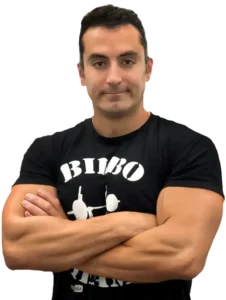
Expert in strength training and physical tests for civil service candidates. With over 30 years of experience and multiple national and European records, he shares his methods to improve strength, endurance, and performance safely.