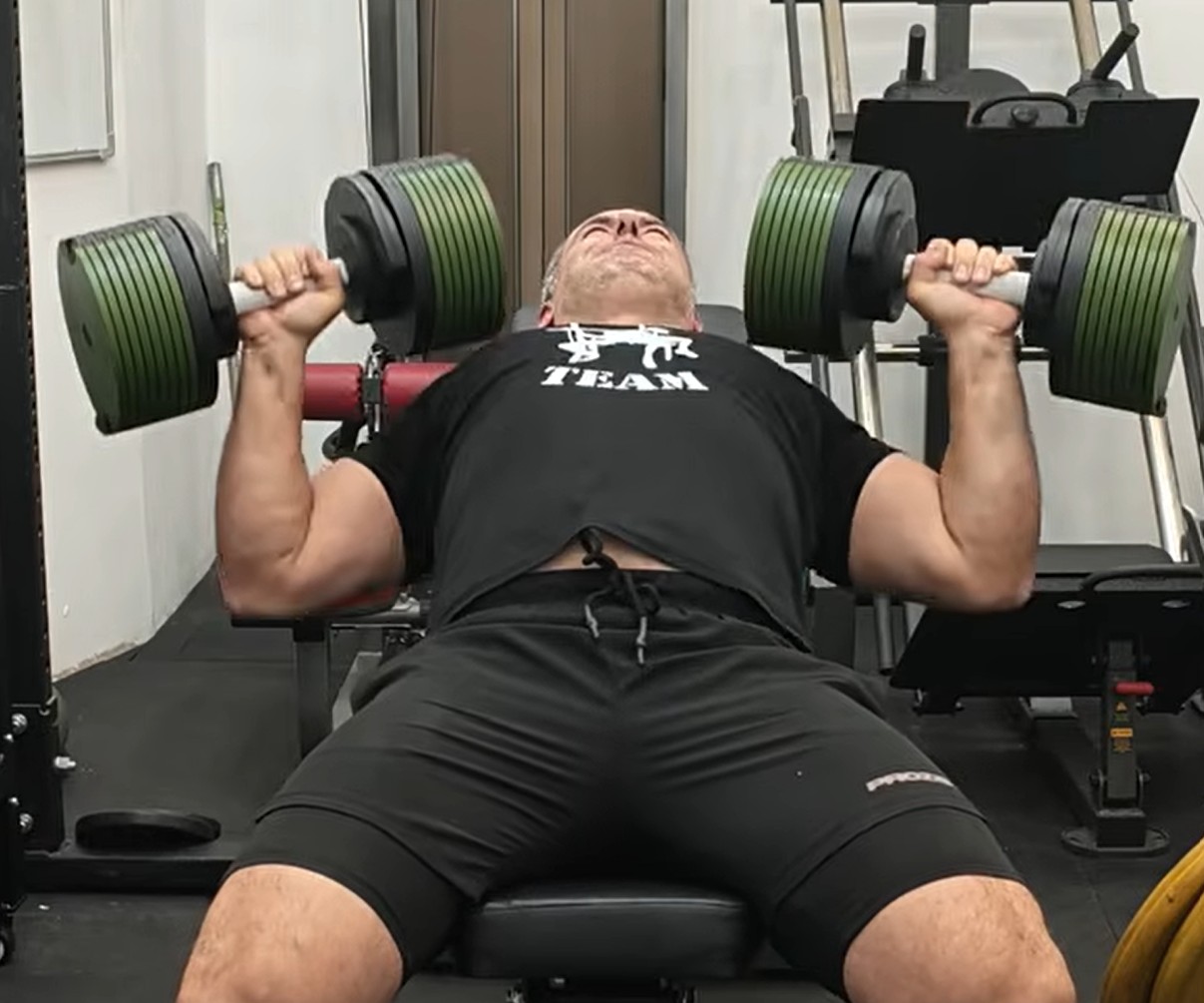
I see the same mistake all the time: people who train hard but have no idea how much they can really bench press.
They train “by feel,” change the weight depending on the day, and by the end of the year they’re exactly where they started. And you need to be clear about this: when you train for strength, there’s one number you want under control—your RM, or rep max.
If you know your RM, you know exactly what weight to use in each set. If you don’t, you’re improvising.
In this post I’ll explain what RM is, how to calculate it with our calculator without having to risk testing your true max in the gym, and most importantly, how to use that number to improve your bench press PR progressively and without getting injured.
Your RM (short for “Repetition Maximum”) is the maximum weight you can lift for a given number of reps.
But here’s something important: your RM isn’t a number that stays the same forever.
Your strength changes. It changes when you train well for weeks, when you build up fatigue, when you rest, when your technique improves, or when you’ve gone a while without training.
That’s why I’m much more interested in using RM as a tracking tool than as a test you have to do constantly.
If your bench press 1RM is 100 kg:
We can program training with different percentages of that RM depending on our goal.
Without that starting point, any percentage I give you is meaningless. It’s the difference between training with a real plan and throwing darts blindfolded.
The problem is that calculating your true 1RM (loading the bar and trying to lift it once, all-out) comes with a risk that just isn’t worth it, especially if you train alone at home or without someone supervising your technique. That’s where the calculator comes in.
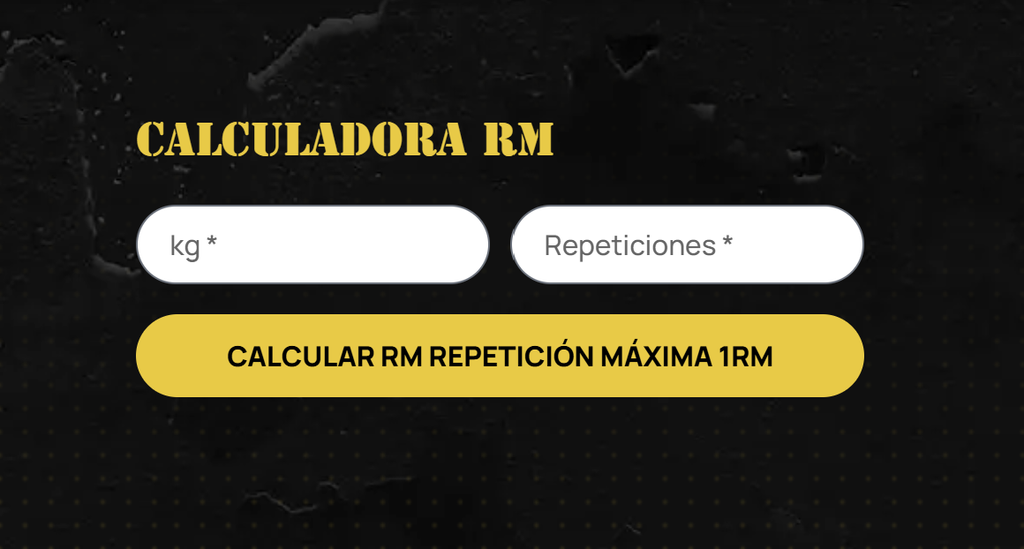
Using an RM calculator is very simple, and you’ve got it available in Bilbo Team. It’s the same one I use for my own training and with everyone who follows the Bilbo Method.
The process is that simple:
It doesn’t need to be very heavy. In fact, it’s better if it isn’t. Pick a weight you can do between 10 and 45 reps with proper form, without failing and without “cheating” any reps.
Meaning: up to the point where you couldn’t do one more while keeping good form. This isn’t the time to grind out a rep “any way you can,” because that skews the input and will give you an inaccurate estimated RM.
Plug those two numbers (the weight you lifted and the number of reps completed) into the calculator, and it automatically gives you your estimated 1RM.
With your RM calculated, you can apply the percentages I mentioned earlier to plan your sets with a clear rationale.
It’s a five-minute process that saves you the risk of attempting a true max before you’re ready—and gives you a reliable number you can work from week to week.
The important part comes next.
The number an RM calculator gives you isn’t worth much if you just look at it and move on. What matters is comparing it to your previous numbers and using it to make decisions about your training.
If your estimated RM is steadily going up, that’s a sign the work is paying off. If it’s been stuck for weeks, it may be time to review your plan, recovery, volume, intensity, or even your execution of the lift.
Be clear: you don’t train at 100% of your RM all the time. In fact, doing that would be a terrible way to approach long-term training.
Depending on the goal, we can work with different loads and rep ranges. Here’s how I do it with anyone following the Bilbo Method:
Use the Bilbo Method strength adaptation, where we work with 1RM percentages above 70%.
Here, the priority is the quality of each rep—not volume.
If your goal is to build strength-hypertrophy, use the percentages detailed in the Bilbo Method training app routines.
👉🏻 The key here is to recalculate your RM every 4–6 weeks. As you progress, your RM goes up—and if you keep training with the same kilos you used two months ago, you’ll be underloading without even realizing it.
Alright—you know your RM and you know how to apply it. Now let’s get to what you really want: pushing that number up.
I’m saying this because one of the things I see most in the gym is people constantly switching routines. One week they do one thing, the next week another, then they try a routine they saw online, and before long they switch again.
That makes it really hard to know what works. If you want to improve your PR, make sure your training has a clear direction.
Don’t focus only on lifting more kilos. You can also progress by doing more reps with the same weight, improving your execution, or making a load that used to feel heavy become more manageable.
The RM calculator can help you turn some of that information into a number you can compare.
The goal isn’t to prove every week how much you can lift. The goal is that in a few months you can lift more than you can today. And that requires training, recovering, and training again.
Strength takes time. It doesn’t make much sense to change a plan before you’ve had the chance to see what results it’s producing. A well-designed progression should let you accumulate work and see how your performance responds.
This is where logging makes all the difference. If you know what weight you used, how many reps you did, and what your estimated RM was, you can compare. And when you compare, you can decide.
This is where many people mess up: they train without writing anything down, and a few weeks later they can’t remember whether they progressed or not. In the Bilbo Method app you’ve got built-in weight and rep tracking, exercise history, and automatic RM calculation—so you can see your real progression without keeping notes on paper.
This is what I want you to take away from everything I’ve explained: RM isn’t a number you need to chase all the time.
It’s a reference point. It lets you measure your strength, track your progress, and better understand how you’re responding to training.
That’s why, in the Bilbo Method, we use progression and tracking as a core part of training. It’s not just about handing you a list of exercises and telling you to train hard.
It’s about knowing what you’re doing today, why you’re doing it, and how your performance is evolving. So if what you really want is to stop improvising and follow a plan with progression, load tracking, exercise history, and ongoing monitoring, that’s where the Bilbo Method Plan comes in.
Remember: the calculator tells you where you are, but training is what actually moves you forward.

Expert in strength training and physical tests for civil service candidates. With over 30 years of experience and multiple national and European records, he shares his methods to improve strength, endurance, and performance safely.