Hey everyone, today we’re going to talk about a topic that generates a lot of controversy in gyms and, especially, on social media: explosive reps and the range of motion in dumbbell exercises.
I often receive comments from people who watch my videos, see me perform a set at maximum speed with heavy weight, drop their criticism saying that “I don’t extend my arms,” and leave without even asking why. Since I know many of you truly want to understand how strength works and not just focus on the show, I’ve prepared this guide. I’m going to explain why training the accelerated concentric phase this way isn’t cheating, but pure biomechanics applied to performance and injury prevention.
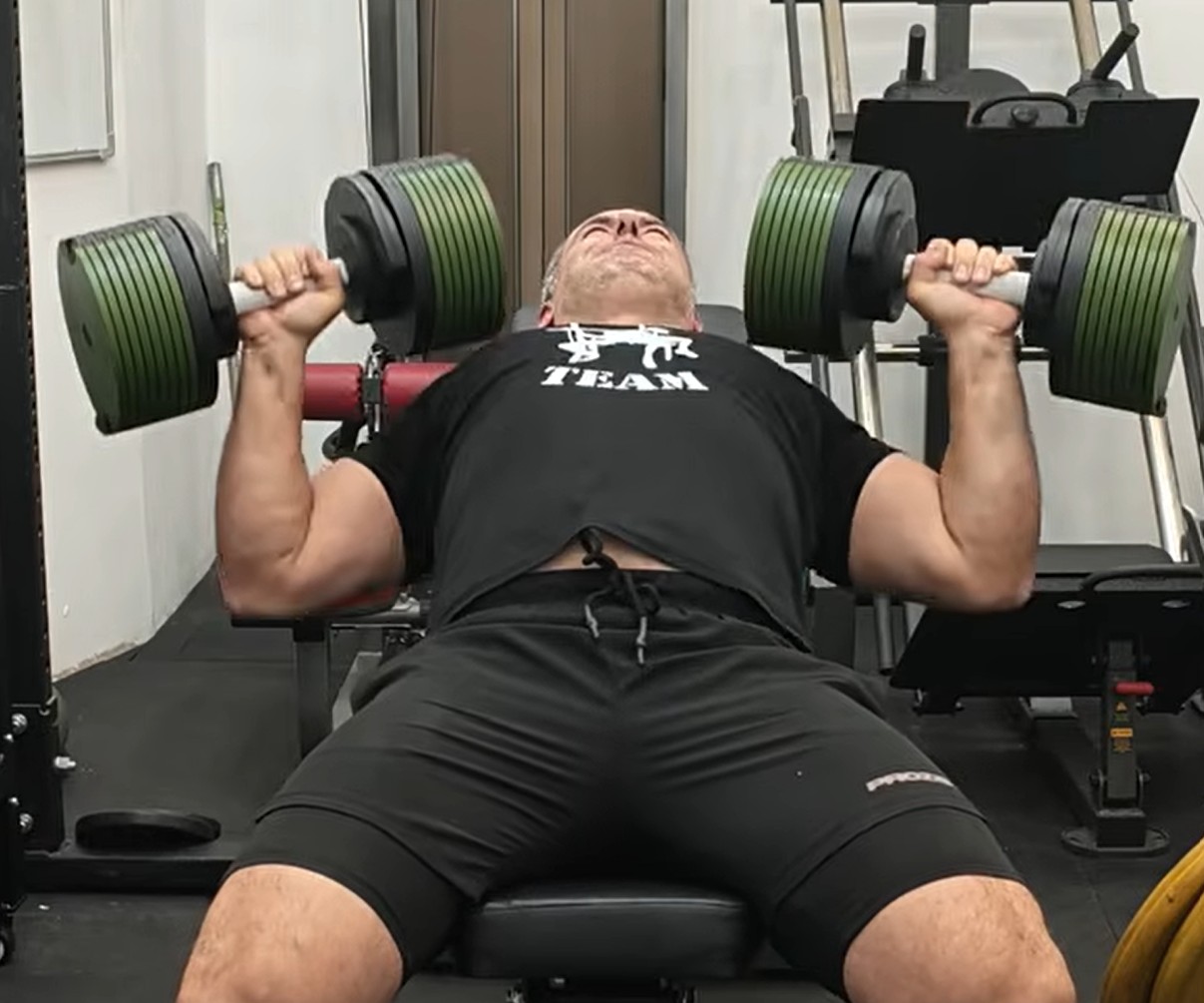
When we talk about explosive reps, we’re referring to executing an exercise at the maximum possible speed during the concentric phase (when you push or lift the weight), always maintaining control of the movement. In the context of my training method, this applies especially to those sets where we lift “light” — and I put light in quotes because for me, lifting 40, 42, or 50 kg per hand in incline press is my weight for high reps.
The main goal of generating this bar speed or explosive force is to recruit the maximum number of fast-twitch (type II) muscle fibers from the very first rep. By moving a weight at full speed, your central nervous system sends a signal of maximum intensity to your muscles, which generates a brutal stimulus for hypertrophy and strength gains.
Doing reps at maximum speed doesn’t mean going crazy. There’s a huge difference between an explosive execution and an uncontrolled movement. What I always aim for is speed within a strictly muscle-controlled movement. That is, the widest possible range of motion for the chest to work thoroughly, but with a conscious restriction at the top lockout so that all the stimulus is concentrated exclusively on the target muscle.
If you just move the dumbbell fast without thinking about your joint alignment, you’re going to end up injuring yourself. The key to success in speed sets is understanding that your muscles are the brakes and motors of the weight, not your tendons or ligaments.
This is where physics comes in and the big question many people have when they see me train. In flat bench press or incline dumbbell press, the weights are completely free. Each arm works independently. This drastically changes the rules of the game compared to using a traditional barbell.
When you do barbell bench press, both sides are connected by a steel shaft. What happens here? I always advise extending your arms up (without violently locking your elbows, but extending them). When doing it with a barbell, no extra tension is produced in the shoulders because the weight cannot spread out to the sides; the bar itself prevents your hands from separating.
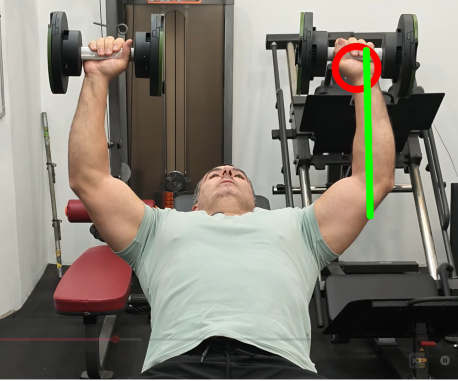
However, what happens with dumbbells? Since they are free weights, if you fully extend your elbows following a straight line upwards, your hands end up separated. At that point, your forearm loses its perpendicularity to the floor, and the dumbbell’s center of gravity is outside your shoulders. This generates tremendous leverage that your shoulders must counteract to prevent the dumbbells from spreading outwards. You are creating unnecessary and dangerous joint tension.
To avoid that shoulder injury when fully extending, traditional biomechanics would tell you to bring the dumbbells together in the center at the end of the movement. And that movement would be perfect if you were going slowly. You go up, and you bring the dumbbells towards the center so that the center of gravity is realigned with the elbow and shoulder.
But remember: we’re doing explosive reps. If, in the middle of a high-speed Bilbo set, I had to go up, bring the dumbbells to the center, open them again, and lower them on each rep… it would be crazy and completely uncontrolled. I would have to constantly brake the movement. That’s why, when I lift heavy and so explosively, my movement ends just before I have to bring the weights together. I cut the range of motion there because it’s the most fluid way to push with the chest while keeping the forearm perpendicular to the floor, just like at the bottom of the bench. Zero tension on the shoulders, one hundred percent of the work on the chest.
There’s a toxic belief in the fitness world that assumes if you don’t do an exercise exactly as it appears in basic manuals from 30 years ago, you’re cheating or feeding your ego. I don’t train to deceive anyone, much less for social media. It would be silly to cheat ourselves; ultimately, training is you against yourself.
I’d much rather explain this in a video or an article than mislead people by making fake demonstrations of something that isn’t how I actually train day-to-day. What I show you is a pure chest exercise, thoroughly tested in my own workouts, where I know perfectly well where I feel the tension in my elbows, shoulders, and back. Changing my technique to please someone who probably doesn’t even lift weights would be absurd.
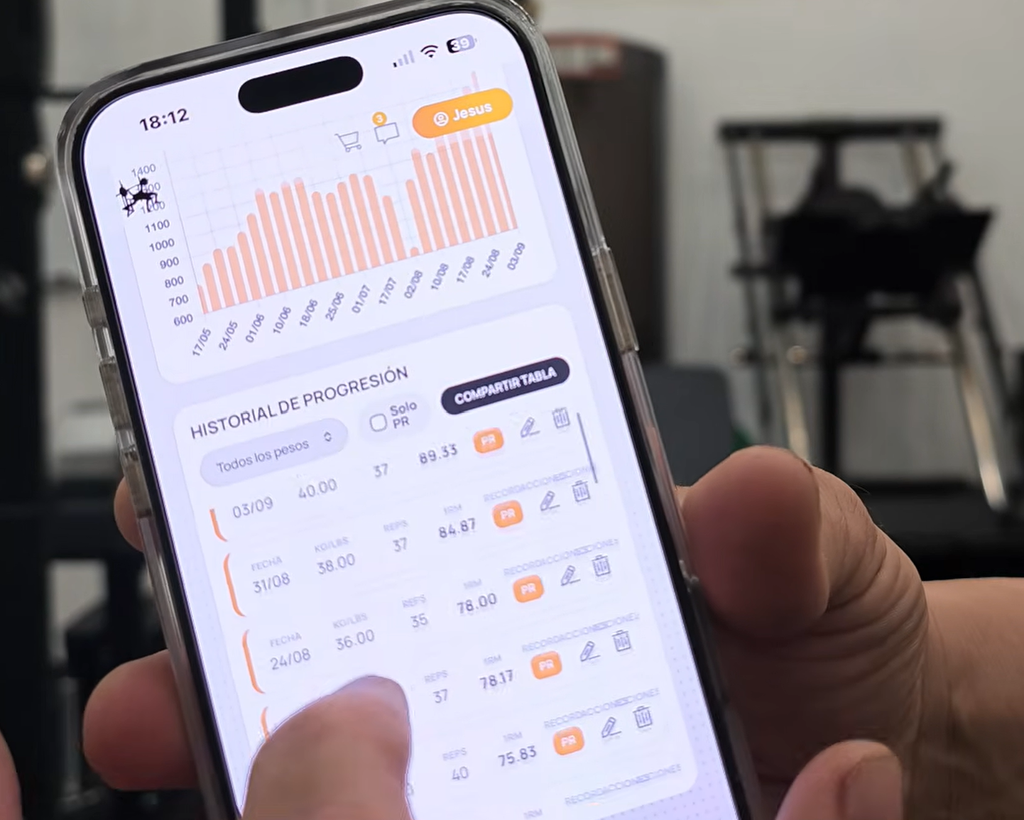
To help you understand that shortening that last part of the range of motion in explosive reps is what boosts performance, I’ll share my real numbers. In the training cycle where I received that criticism, you can see my recorded progression.
At the beginning of that cycle, lifting with 40 kg dumbbells, I managed 26 reps. Applying this speed technique without locking elbows and maintaining constant tension, in my last workout I hit 37 reps with those same 40 kg. We’re talking about adding 11 more reps to an already enormous weight in just one cycle. It’s absolutely insane how the progression is going. My next workout is 42.5 kg, and knowing how the weights are flying right now, I know they’re going to be crushed.
If you want to apply this philosophy to your workouts and get the most out of your speed sets, you need to master the technique before increasing the weight. It’s not about grabbing heavy dumbbells and bouncing them.
First, select a weight you feel safe with and can do more than 30 or 40 reps. Start the movement from the lowest point and push with the greatest possible intention of speed. Your focus should be on the target muscle (in this case, the chest) and not just on moving the load from point A to point B. You’ve just done your first Bilbo set!!! Now keep applying the method in your subsequent workouts.
The golden rule for avoiding injury is to watch your forearm. Throughout the explosive execution, your forearm should aim to be perpendicular to the floor. The moment you feel that, when pushing, your hands are wider than your elbows, stop there and reverse the movement.
Don’t let the dumbbell’s center of gravity shift outwards. If you find that to extend your arms you need to brake abruptly to bring the dumbbells together at the top, you’re losing the explosive stimulus. Cut the range of motion exactly at the point where the dumbbell, elbow, and shoulder are in a safe vertical alignment. This is how you maintain weight balance, prevent rotator cuff strain, and ensure your pectorals get 100% of the hypertrophy.
No. In barbell exercises (connected weight), you can extend without issue because there are no lateral forces that would spread your arms. In dumbbell exercises (free weights), fully extending without bringing the weights together puts your shoulders at risk.
On the contrary. By avoiding joint lockout and not bringing the dumbbells together, you maintain constant mechanical tension on the chest. In explosive reps, this continuous muscle control is a brutal stimulus for hypertrophy.
Only if you do them without control or with poor alignment. If you keep your forearm perpendicular to the floor and the center of gravity aligned with your elbows, it’s a very safe way to train because you adapt the technique to your biomechanics.
It depends on your level, but in a “Bilbo set,” we usually aim for weights that allow us to hit high ranges (15 to 40 or 50 reps) to generate that speed without losing control of the technique from the first rep.
Training explosive reps with dumbbells requires thinking beyond classic dogmas. Shortening the upper lockout isn’t cheating; it’s protecting your shoulders, keeping your forearm aligned, and ensuring the muscle works to its maximum without interruption. Try doing it while maintaining speed and constant tension, and then tell me if you’re able to bring the weights together on each rep without slowing down.
That’s all, everyone. If you want to have absolute control over these progressions, remember that you can download the Bilbo Method training app from bilboteam.com and use my discount codes for equipment.
Keep crushing it!

Expert in strength training and physical tests for civil service candidates. With over 30 years of experience and multiple national and European records, he shares his methods to improve strength, endurance, and performance safely.